Game development outsourcing has evolved far beyond simply hiring an external programmer to complete unfinished features. In 2026, studios and publishers are using external development partners for full production, co-development, technical art, multiplayer engineering, porting, QA, live operations, and specialized technologies such as AR, VR, and AI.
The market is also becoming more specialized. Current industry research estimates the global game outsourcing services market at roughly $1.96 billion in 2026, while mobile game development outsourcing alone is estimated at approximately $2.21 billion. Different research methodologies produce different market estimates, but the direction is consistent: external development is becoming an important production model rather than a purely cost-saving tactic.
At the same time, development teams are under pressure to prototype faster, control production risk, support more platforms, and maintain games after launch. Unity's 2026 industry report found that 52% of surveyed developers prioritize smaller projects as a risk-reduction strategy, while 67% reported prototype phases of three months or less.
This guide explains how game development outsourcing works in 2026, what you can outsource, how to choose an outsourcing partner, realistic cost considerations, technical architecture requirements, and how to structure an engagement that protects quality, IP, schedule, and budget.
Key Takeaways & Executive Summary
- Game development outsourcing can cover anything from individual engineering tasks to complete game production and LiveOps.
- The best outsourcing model depends on scope, internal capabilities, IP ownership, technical complexity, and required delivery speed.
- Unity and Unreal outsourcing requires more than engine familiarity; evaluate networking, rendering, optimization, build pipelines, platform SDKs, and production architecture.
- Cost should be evaluated against delivered milestones and engineering quality, not simply the lowest hourly rate.
Quick Comparison & Market Overview
The right outsourcing model depends heavily on what your internal team already owns and where external specialists can create the most leverage.
| Outsourcing Model | Core Scope | Best For | Typical Engagement |
|---|---|---|---|
| Full-Cycle Development | Design, engineering, art, QA, release | New games and startups | Project-based |
| Co-Development | External team extends internal developers | Publishers and established studios | Dedicated team |
| Engineering Outsourcing | Gameplay, backend, systems, optimization | Technical capacity gaps | Time & materials |
| Art Outsourcing | 2D, 3D, animation, VFX | Asset-heavy projects | Milestone-based |
| QA & Certification | Functional, performance, device and platform testing | Pre-launch and LiveOps | Retainer/project |
| LiveOps Outsourcing | Updates, events, optimization, maintenance | Existing live games | Monthly retainer |
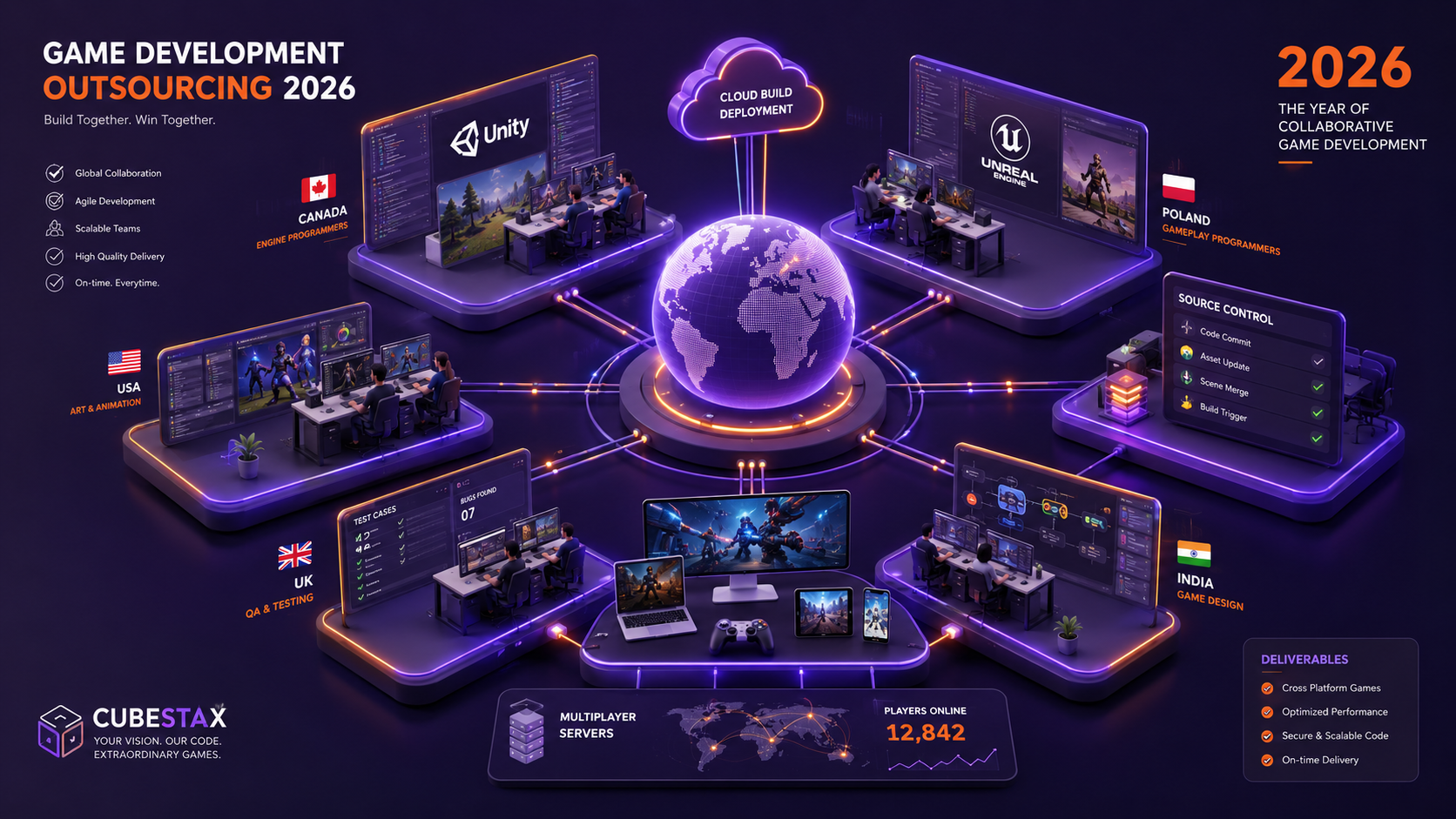
What Is Game Development Outsourcing?
Game development outsourcing is the process of contracting an external development company, studio, or specialist team to perform some or all activities required to build and operate a game. The outsourced scope can include:
- Game design implementation
- Unity or Unreal Engine programming
- Multiplayer and networking
- Backend development
- D and 3D art
- Character and environment production
- Animation
- VFX and shaders
- UI/UX
- AR/VR development
- Porting
- Optimization
- QA and compatibility testing
- DevOps and build automation
- LiveOps
- Post-launch maintenance
The key distinction is that modern outsourcing is not necessarily about transferring the entire project outside your company.
A publisher may retain creative direction, product strategy, monetization, IP, and community management internally while using an external team for engineering and content production.
This hybrid approach is often called co-development.
1. Full-Cycle Game Development Outsourcing
Full-cycle outsourcing means an external studio takes responsibility for a significant portion of the development pipeline, potentially from prototype through release.
A full-cycle team may provide:
- Technical architecture
- Gameplay programming
- UI/UX implementation
- D and 3D art
- Animation
- Audio integration
- Multiplayer
- Backend systems
- QA
- Platform builds
- Store submission support
- Post-launch maintenance
This model is particularly useful for startups, publishers entering a new platform, and companies without an established internal game engineering department.
For teams looking for a complete external production capability, CubeStax provides Game Development services covering multiple game technologies and platforms.
Technical considerations
Full-cycle development requires clearly defined ownership boundaries.
Before production starts, establish who owns:
- Game architecture
- Source repositories
- Cloud infrastructure
- CI/CD pipelines
- Art source files
- Build credentials
- Analytics
- Backend services
- Third-party SDK accounts
- Store accounts
- Intellectual property
A common mistake is allowing an outsourcing partner to become the only organization capable of building or deploying the game.
A better architecture keeps your organization in control of source code, cloud accounts, signing credentials, production analytics, and IP.
Key Highlights
- Best for: New games and teams without sufficient internal capacity
- Platforms: Mobile, PC, console, Web, AR/VR
- Technology: Unity, Unreal Engine, backend services, cloud infrastructure
- Engagement: Fixed-price, milestone-based, or dedicated team
- Main advantage: One partner can coordinate multiple production disciplines
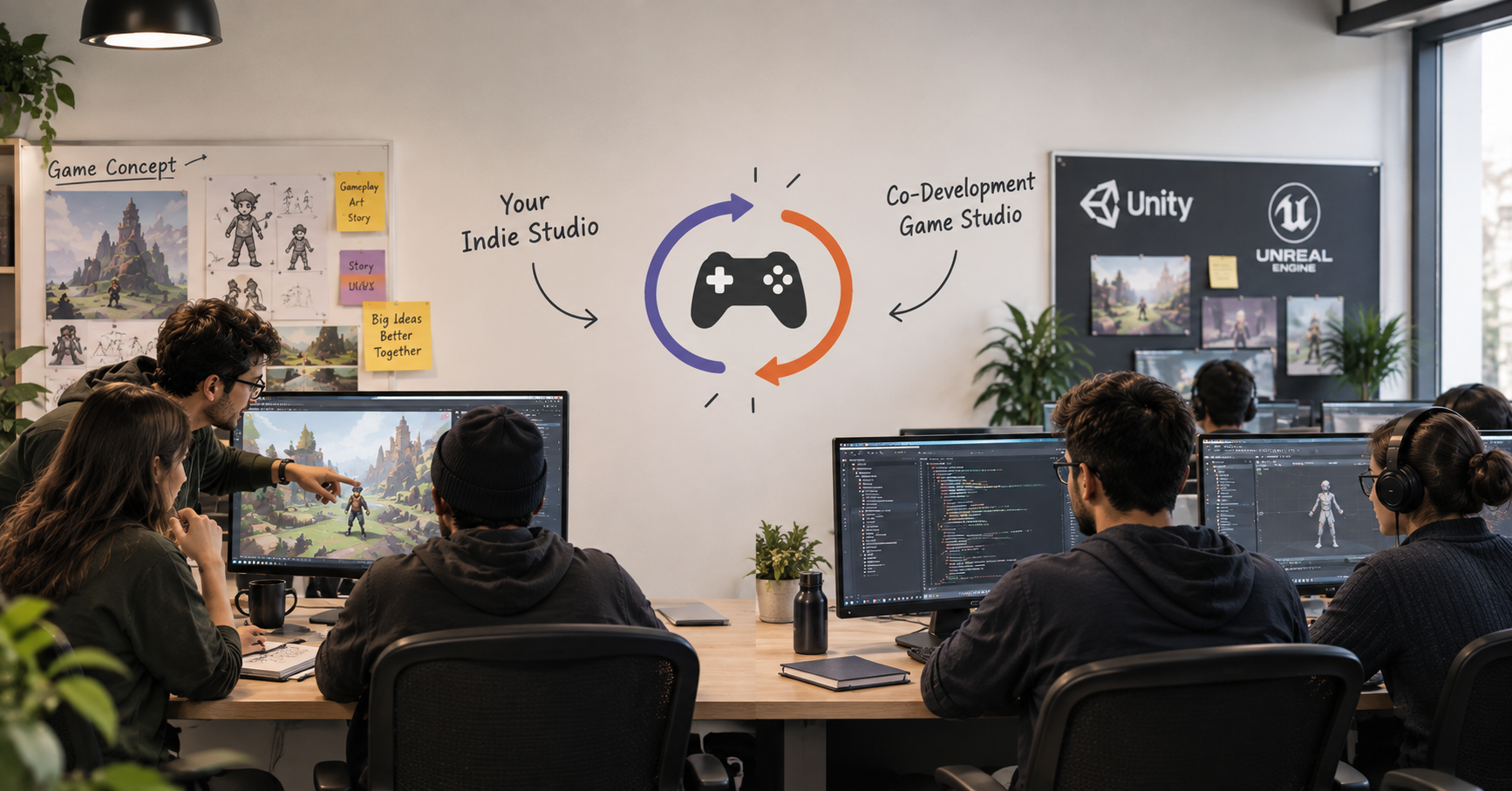
2. Game Co-Development
Co-development is one of the most practical outsourcing models for established studios.
Instead of handing over the entire game, the internal team and external team work as one distributed production organization.
For example:
Internal team:
- Creative direction
- Product management
- Game design
- IP ownership
- Core gameplay systems
External team:
- Gameplay engineering
- Technical art
- UI implementation
- Multiplayer systems
- QA
- Porting
- Content production
This model can increase production capacity without requiring the publisher to permanently expand its internal headcount.