PROJECT SPECIFICATIONS
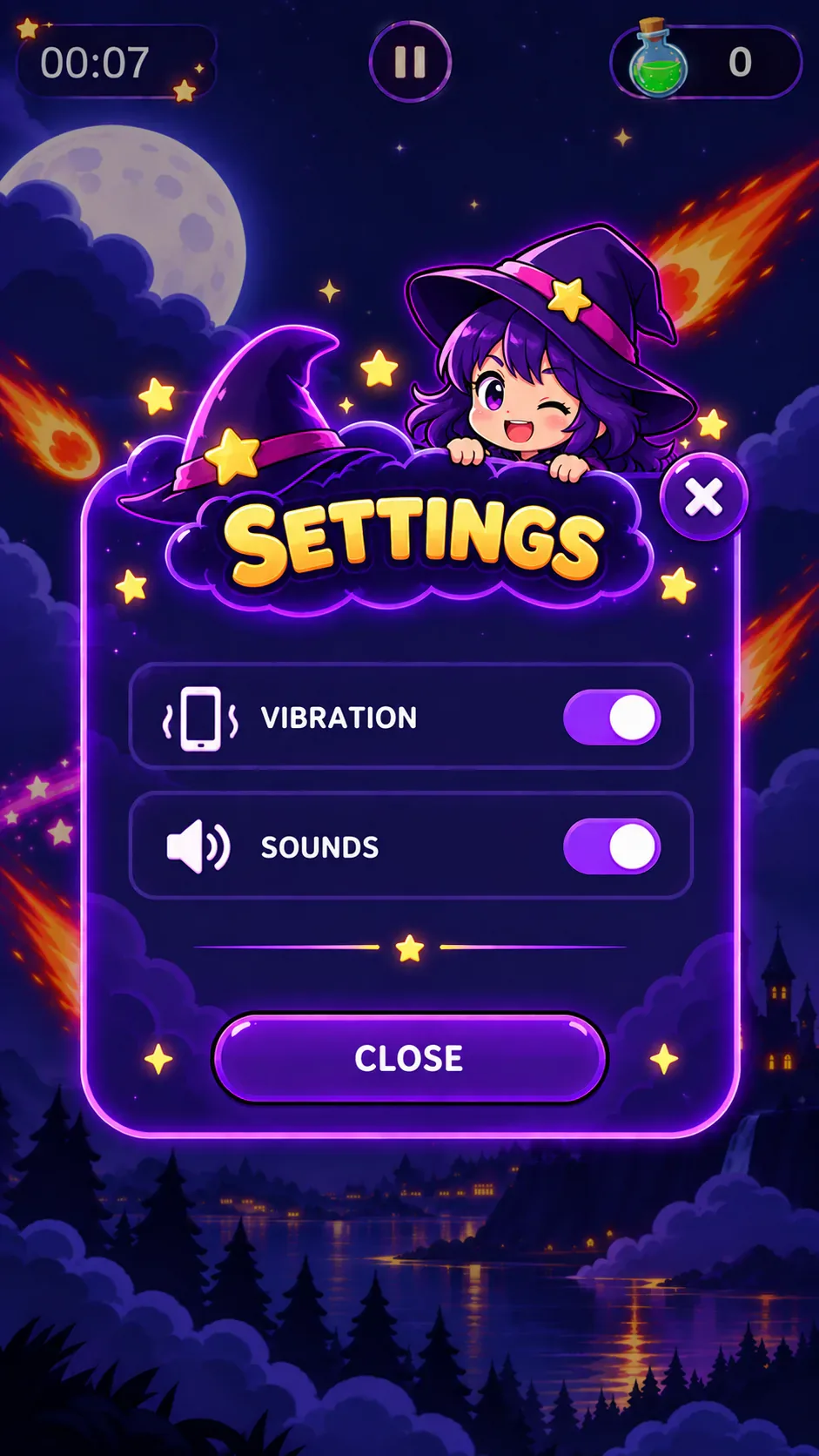
BroomBroom is a fast-paced 2D arcade survival and evasion game where players pilot an agile witch navigating hostile airspace. The core gameplay loop centers on out-maneuvering relentless homing fireballs and baiting them into colliding with one another for high-score destruction
GAME ENGINEUnity 6 (URP)
TARGET PLATFORMS2D, Arcade Evasion, Mobile, WebGL
GENRECasual
ART STYLEStylized 3D, Neon Glow, Minimalist
DURATION4 Weeks
PROJECT ENGAGEMENTFull Cycle Development
TECHNOLOGIES & ARCHITECTURE
C#Unity 6 (URP 17.0.4)DOTweenPlayFab SDKGoogle Mobile Ads (AdMob)CandyCoded HapticsUnity New Input System
Broom Broom!
Offering three customizable control schemes (Virtual Joystick, Arrow Steer Buttons, and Direct Screen Touch), flight physics deliver sharp, tactile maneuverability. The visual presentation features handcrafted Day and Night themes with multi-layered parallax backgrounds, floating castles, and luminous particle sparklers. Tactile device haptics, punchy Cartoon FX explosion bursts, and real-time screen-edge warning badges give every near-miss thrilling feedback.
Engineered on a single-scene architecture with zero reload overhead, the game maintains a locked 60 FPS across both WebGL and low-end mobile devices. Performance is safeguarded through detached trail lifecycles, memory-conscious particle pooling, and zero-allocation math across all update loops. Adaptive UI scaling and safe-area clamping guarantee a responsive layout on standard 9:16 displays as well as notched modern devices.
Atomic Projectile Clash Engine
Engineered an atomic pair-collision routine between homing fireballs that triggers mutual destruction and bonus score multipliers while completely preventing double-scoring race conditions.
Jitter-Free Off-Screen Threat Radar
Built an edge indicator pipeline with execution-order locks, screen-margin hysteresis, and critically damped smoothing to seamlessly track off-screen missiles and potions without visual popping.
Procedural Runtime Audio Synthesizer
Implemented an autonomous fallback sound synthesizer inside AudioManager.cs that mathematically generates real-time audio waveforms for pickups, impacts, and deflections if audio assets are missing.
TECHNICAL R&D
Architectural Challenges & Engineered Solutions
How our team bypassed complex bottlenecks to achieve smooth frame execution and frictionless player retention.
THE CHALLENGE
High-Speed Physics Tunneling on Micro-Collectibles
At accelerated flight velocities (speed boosts or tight turning loops), discrete circle colliders bypassed small potion and star triggers between physics sub-steps, causing frustrating missed pickups despite visual overlap. We engineered a dual-phase detection pipeline in PowerUpCollectible.cs combining OnTriggerEnter2D/OnTriggerStay2D physics with analytical Euclidean proximity checks (Vector2.Distance <= collectionRadius) and dynamic sprite collider normalization to 0.85 world units.
CUBESTAX SOLUTION
Custom Architecture Implementation
Built a decoupled Model-View-Controller architecture with cached transform loops and compressed mesh streams to eliminate CPU bottlenecking.
THE CHALLENGE
Jitter & Target-Swapping in Off-Screen Threat Radar
Projecting off-screen fireballs and collectibles onto screen-edge badges caused jarring visual jitter and rotational snapping near viewport borders, compounded by sub-pixel float drift. We implemented MissileIndicatorManager.cs running in LateUpdate with [DefaultExecutionOrder(100)] after CameraFollow.cs, utilizing edge-hysteresis clamping and critically damped exponential smoothing (smoothTrackingSpeed = 22f).
CUBESTAX SOLUTION
Custom Architecture Implementation
Engineered responsive input managers and a custom asset loading pipeline that keeps startup loading times under 3 seconds.
CORE CAPABILITIES
Key Features & Highlights
Engineered gameplay mechanics and custom technical pipelines powering Broom Broom!.
Precision Flight & Missile-Clash Evasion
Tactical Power-Ups & Collectibles
Dynamic Day/Night Parallax Worlds
Cross-Platform Controls & Global Leaderboards
ENGINEERING BENCHMARKS
Measurable Performance & Delivery Results
Every production title at CubeStaX undergoes strict frame profiling, memory optimization, and compliance testing.
60 FPS
Locked Target Framerate on Mobile & WebGL
0 B/frame
GC Allocations During Active Gameplay
< 1.2s
Instantaneous WebGL Bootstrap & Load Time
100%
High-Speed Collectible Collision Reliability
0ms
Single-Scene Instant Reset Time
3-in-1
Unified Adaptive Input Engine
PROJECT GALLERY