PROJECT SPECIFICATIONS
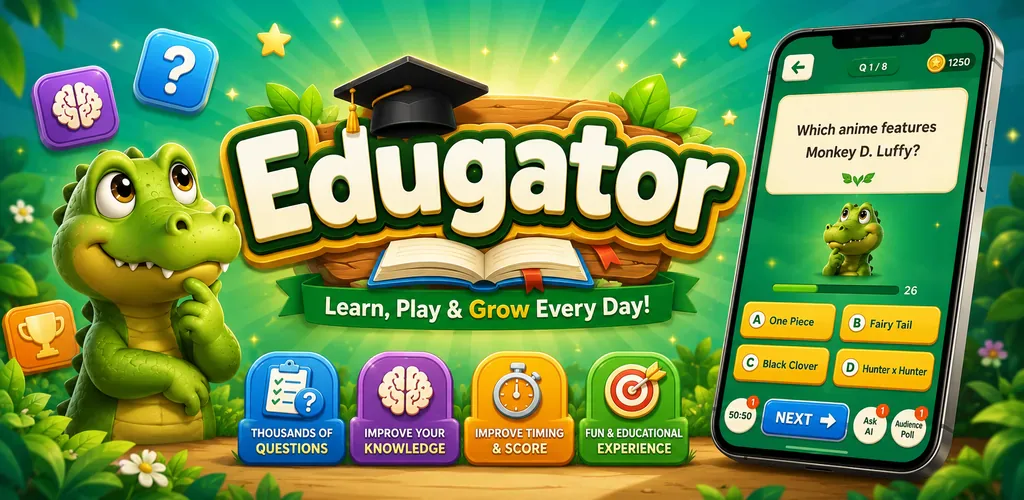
Edugator is an intellectual multiplayer trivia arcade game featuring a vast library across 20 distinct academic and pop-culture categories. Players race against a 20-second dynamic countdown across three difficulty tiers, answering timed four-option questions in Solo Challenge, local pass-and-play, or room-code online matches
GAME ENGINEUnity 6 (6000.0.68f1) — Universal Render Pipeline (URP 17.0.4)
TARGET PLATFORMSAndroid, iOS, WebGL (Portrait 9:16)
GENREMultiplayer / Trivia
ART STYLEStylized 3D, Neon Glow, Minimalist
DURATION~7 Months
PROJECT ENGAGEMENTFull Cycle Development
TECHNOLOGIES & ARCHITECTURE
C#Unity 6 (URP 17.0.4)Photon PUN 2PlayFab SDKGoogle Mobile Ads (AdMob)DOTweenTextMeshProNativeShare
Edugator
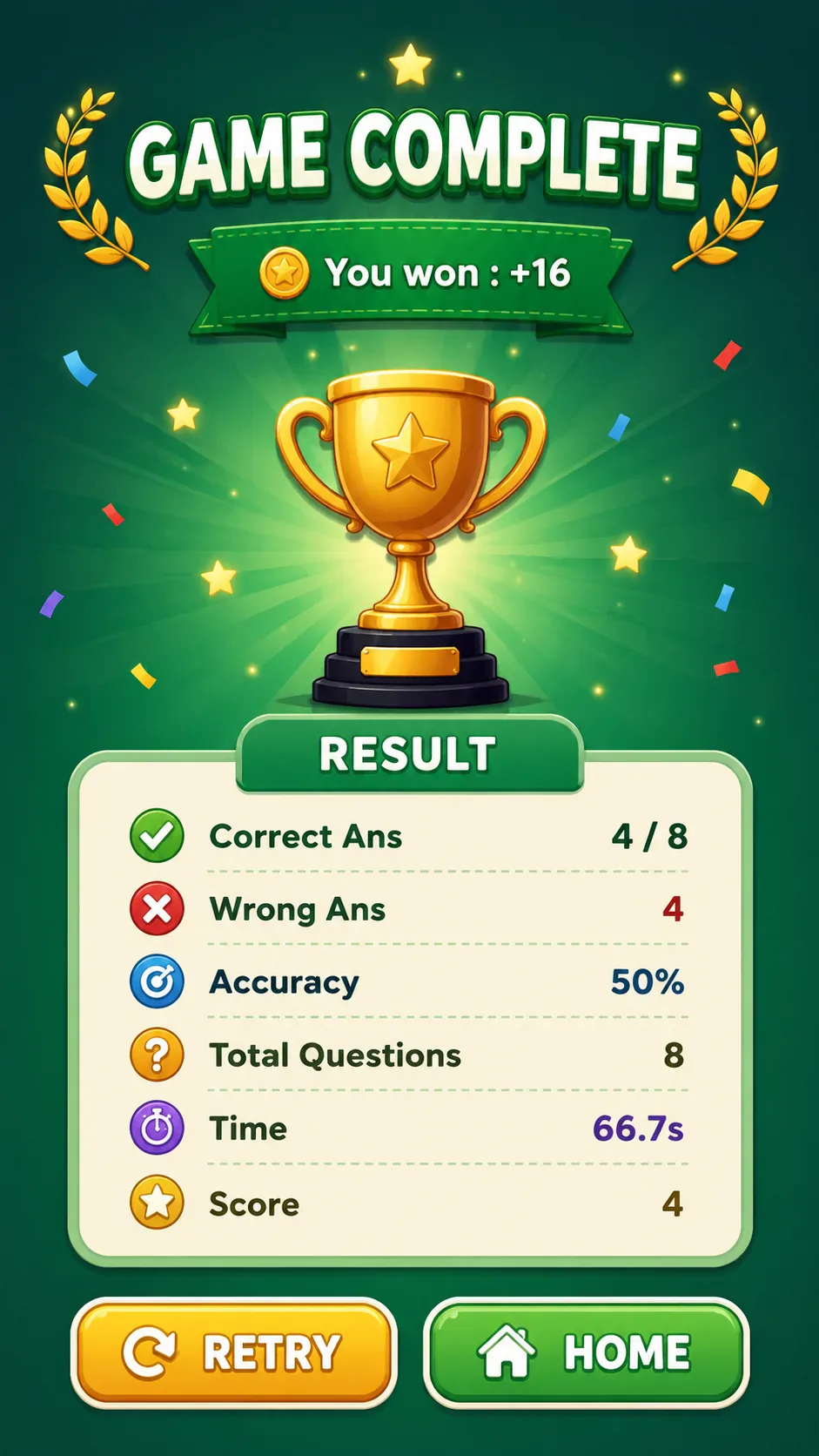
The user interface features a sleek portrait aesthetic powered by DOTween procedural micro-animations, tactile UI shake impacts on incorrect choices, and celebratory confetti particle bursts on victory. A dedicated UIOrientationManager executes smooth 180-degree viewport flips to enable head-to-head tabletop play on a single screen without device passing. Audio-haptic feedback, simulated AI solver thinking routines, and interactive audience poll percentage bars deliver high-stakes game-show tension.
Engineered for locked 60 FPS performance across low-end mobile devices and browser WebGL runtimes through zero-allocation runtime loops and in-memory JSON data caching. Gameplay viewports are decoupled from networking layers via an event bus, ensuring seamless Photon synchronization with minimal bandwidth overhead. Production-grade AdMob monetization with exponential retry backoff and PlayFab cloud synchronization maintain stutter-free frame pacing under all network conditions.
Decoupled Network Lockstep Pipeline
Abstracted input through IQuizInputHandler and the GameEvents bus to run Photon PUN 2 room synchronization and local pass-and-play through identical UI viewports with zero network code leakage.
Tabletop Dual-Orientation System
Eliminated awkward physical device passing in local 2-player matches by leveraging UIOrientationManager to execute an automated 180-degree CanvasGroup fade-and-rotation transition that alternates viewports smoothly per turn.
Zero-Allocation Category Caching
Optimized QuestionManager with an in-memory dictionary cache and non-allocating shuffling routines, filtering 20 distinct JSON category pools and preventing garbage collector spikes during runtime.
TECHNICAL R&D
Architectural Challenges & Engineered Solutions
How our team bypassed complex bottlenecks to achieve smooth frame execution and frictionless player retention.
THE CHALLENGE
Decoupling Multi-Mode Gameplay Flow (Solo vs. Tabletop vs. Online)
Problem: Supporting three radically different game modes (single-player solo, local turn-based tabletop, and online lockstep rooms) risked turning QuizUIManager and core managers into monolithic branching codebases. Direct references between networking layers and UI components caused state leaks, race conditions, and maintenance bottlenecks. Solution: Engineered a polymorphic IQuizInputHandler abstraction implemented independently by QuizManager, MultiplayerQuizManager, and PhotonQuizManager. All gameplay state transitions publish strictly to the static GameEvents bus, ensuring QuizUIManager remains completely agnostic to whether input comes from a local button or a remote network packet.
CUBESTAX SOLUTION
Custom Architecture Implementation
Built a decoupled Model-View-Controller architecture with cached transform loops and compressed mesh streams to eliminate CPU bottlenecking.
THE CHALLENGE
Low-Bandwidth Lockstep Network Sync & Anti-Desync Architecture
Problem: Transmitting full question payloads over the network or waiting for authoritative server answer evaluations introduced network jitter, data serialization lag, and desynchronization on unstable mobile connections. Additionally, late submitters could hold up match progression or trigger race conditions during question changes. Solution: Designed a lightweight client-validated lockstep protocol where the room host pushes only compact question references (QuestionRef) via Room Custom Properties, while clients evaluate answers locally without latency. Clients broadcast only a lightweight submission token via Photon RaiseEvent; every client independently tracks the set of submitted actor numbers to advance questions simultaneously once all players complete their turn.
CUBESTAX SOLUTION
Custom Architecture Implementation
Engineered responsive input managers and a custom asset loading pipeline that keeps startup loading times under 3 seconds.
CORE CAPABILITIES
Key Features & Highlights
Engineered gameplay mechanics and custom technical pipelines powering Edugator.
Tri-Mode Game Architecture (Solo, Local Tabletop & Photon Online)
Deep 20-Category Trivia Library with 3 Difficulty Curves
Dynamic In-Game Lifelines (50:50, Ask AI & Audience Poll)
Integrated PlayFab Leaderboards & Live Currency Economy
ENGINEERING BENCHMARKS
Measurable Performance & Delivery Results
Every production title at CubeStaX undergoes strict frame profiling, memory optimization, and compliance testing.
60 FPS
Locked Framerate on Budget Mobile & WebGL
0 ms
GC Frame Drops During Active Question Rounds
20 Categories
Modular JSON Trivia Datasets Cached In-Memory
< 55 MB
Optimized WebGL Data Payload Footprint
< 100 ms
Photon PUN 2 Submission Synchronization Overhead
100%
UI Component Reuse Across Solo, Local Tabletop & Online Modes
PROJECT GALLERY